BackLie Bracket and Torsion Tensor
In order to work with the Lie bracket, we need to consider the meaning of "travelling along" a vector field. Consider a vector field v=ex+xey. This vector field tells us the velocity of a curve parametrized by λ:
dλd=dλdxey+dλdyey=ex+xey, this gives us the following partial differential equations with solutions:
dλdxdλdy=1,=x, with the solutions:
x(λ)y(λ)=λ+x0,=21λ2+x0λ+y0, where x0 and y0 describe the initial position. These are equations for a flow curve. Flow curve is a curve tangent to all vectors in a vector field.
The Lie bracket, also called the commutator, is defined as follows:
[u,v]=u(v)−v(u), this tells us the difference between applying u to v and applying v to u. The Lie bracket may be expanded:
[u,v]=uμ∂xμ∂(vν∂xν∂)−vμ∂xμ∂(uν∂xν∂)=uμ(∂xμ∂vν∂xν∂+vν∂xμ∂∂xν∂)−vμ(∂xμ∂uν∂xν∂+uν∂xμ∂∂xν∂)=uμ∂xμ∂vν∂xν∂+uμvν∂xμ∂∂xν∂−vμ∂xμ∂uν∂xν∂−vμuν∂xμ∂∂xν∂=uμ∂xμ∂vν∂xν∂−vμ∂xμ∂uν∂xν∂=(uμ∂xμ∂vν−vμ∂xμ∂uν)eν. As an example, consider the following vector fields:
uv=ex,=xey. 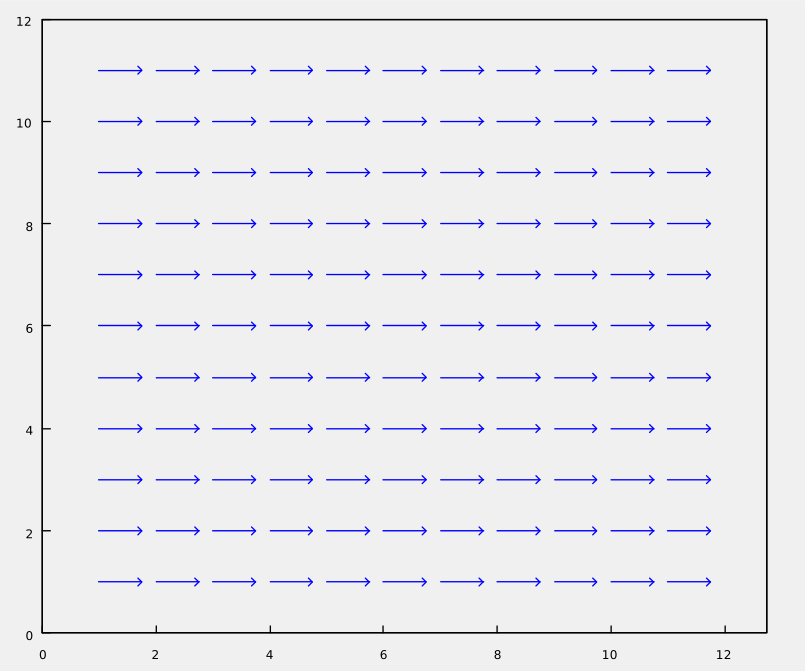
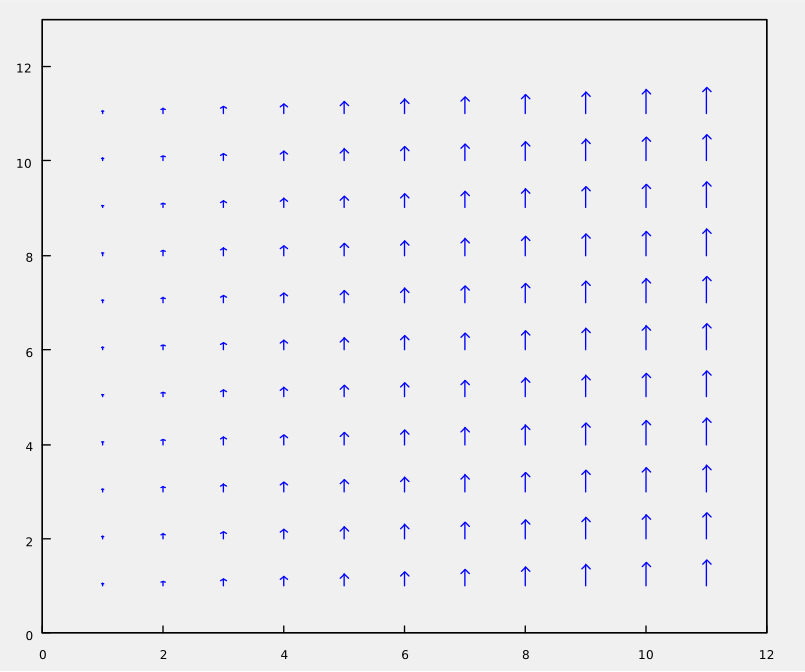
u
v
The Lie bracket is equal to:
[u,v]=(uμ∂xμ∂vx−vμ∂xμ∂ux)ex+(uμ∂xμ∂vy−vμ∂xμ∂uy)ey=(ux∂x∂vx−vy∂y∂ux)ex+(ux∂x∂vy−vy∂y∂uy)ey=ey. Looking at both vector fields in one plot:
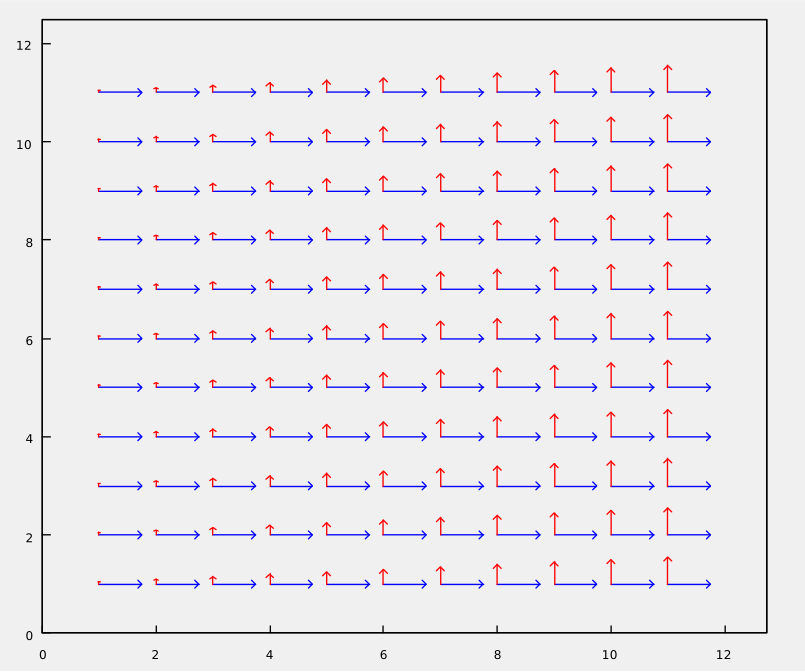
Blue: u
Red: v
(Not to scale)
We can make sense of this by considering the flow curves. We start at a point and travel along the blue vector field (u) and this changes the vector field v. Then we go back to the same point and travel along the red vector field (v) and this changes the vector field u (not in this specific case). The difference is the Lie bracket:
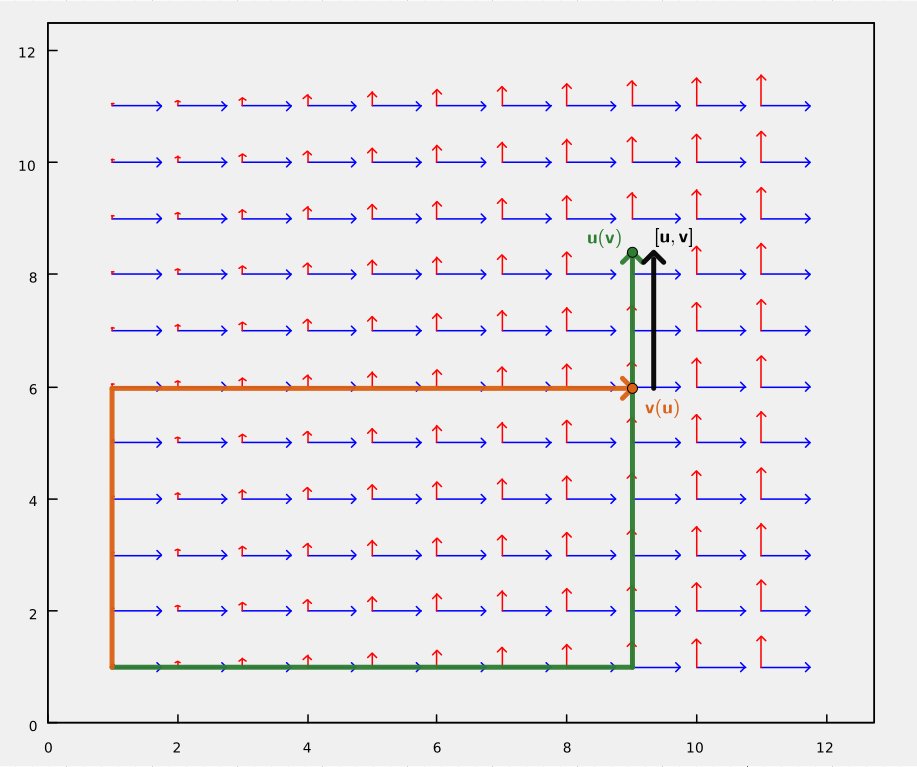
Green: u(v)
Orange: v(u)
Black: [u,v]=u(v)−v(u)
(Not to scale)
When the lie bracket is zero, it means that the flow curves form a closed loop.
We may also say that the coordinate lines are the flow curves along basis vectors. And their Lie bracket is zero:
[eμ,eν]=∂xμ∂(∂xν∂)−∂xν∂(∂xμ∂)=∂xμ∂xν∂2−∂xν∂xμ∂2=0, and this is good. It means that the coordinate lines close.
The torsion tensor T(u,v) acting on the vectors u and v tells us the separation between parallel transported vectors:
where vp is parallel transport of v and up is parallel transport of u. The covariant derivative measures how much a vectors changes relative to the parallel transform of the vector. We don't know the parallel transported vector. But we can still express the torsion tensor as follows:
T(u,v)=∇uv−∇vu−[u,v]. Torsion-free property is a property of a connection, meaning it does not depend on the vector fields we choose. It means that the torsion tensor is zero:
T(u,v)=∇uv−∇vu−[u,v]=0. We can solve for the components:
T(u,v)=∇uv−∇vu−[u,v]=uμ(∂xμ∂vσ+vνΓσμν)eσ−vμ(∂xμ∂uσ+uνΓσμν)eσ−(uμ∂xμ∂vσ−vμ∂xμ∂uσ)eσ=(uμ∂xμ∂vσ+uμvνΓσμν−vμ∂xμ∂uσ−vμuνΓσμν−uμ∂xμ∂vσ+vμ∂xμ∂uσ)eσ=(uμvνΓσμν−vμuνΓσμν)eσ=(uμvνΓσμν−uμvνΓσνμ)eσ=uμvν(Γσμν−Γσνμ)eσ, so the components of the torsion tensor are:
Tσμν=Γσμν−Γσνμ, which only depend on the connection.
And again, the torsion-free property means that the torsion tensor components are zero:
Tσμν=Γσμν−ΓσνμΓσμν=0,=Γσνμ. We could also express the torsion tensor as follows:
Tσμν=2Γσ[μν], where the brackets mean that the components are symmetrized. For any general tensor:
A[μ1μ2...μn]νσ=n!1(Aμ1μ2...μnνσ+alternating sum over permutations of μ indices), where alternating sum means minus for odd permutations and plus for even permutations.
For a general tensor, components may be symmetrized:
A(μ1μ2...μn)νσ=n!1(Aμ1μ2...μnνσ+sum over permutations of μ indices). A tensor having symmetric or antisymmetric components means:
AμνBμν=Aνμ=−Bνμsymmetric,antisymmetric. A tensor with symmetrized components A(μ1μ2...μn)νσ or antisymmetrized components A[μ1μ2...μn]νσ is not the same tensor as Aμ1μ2...μnνσ.
For a torsion free connection, the Christoffel symbols are the same as symmetrized:
Γσμν=Γσ(μν). 