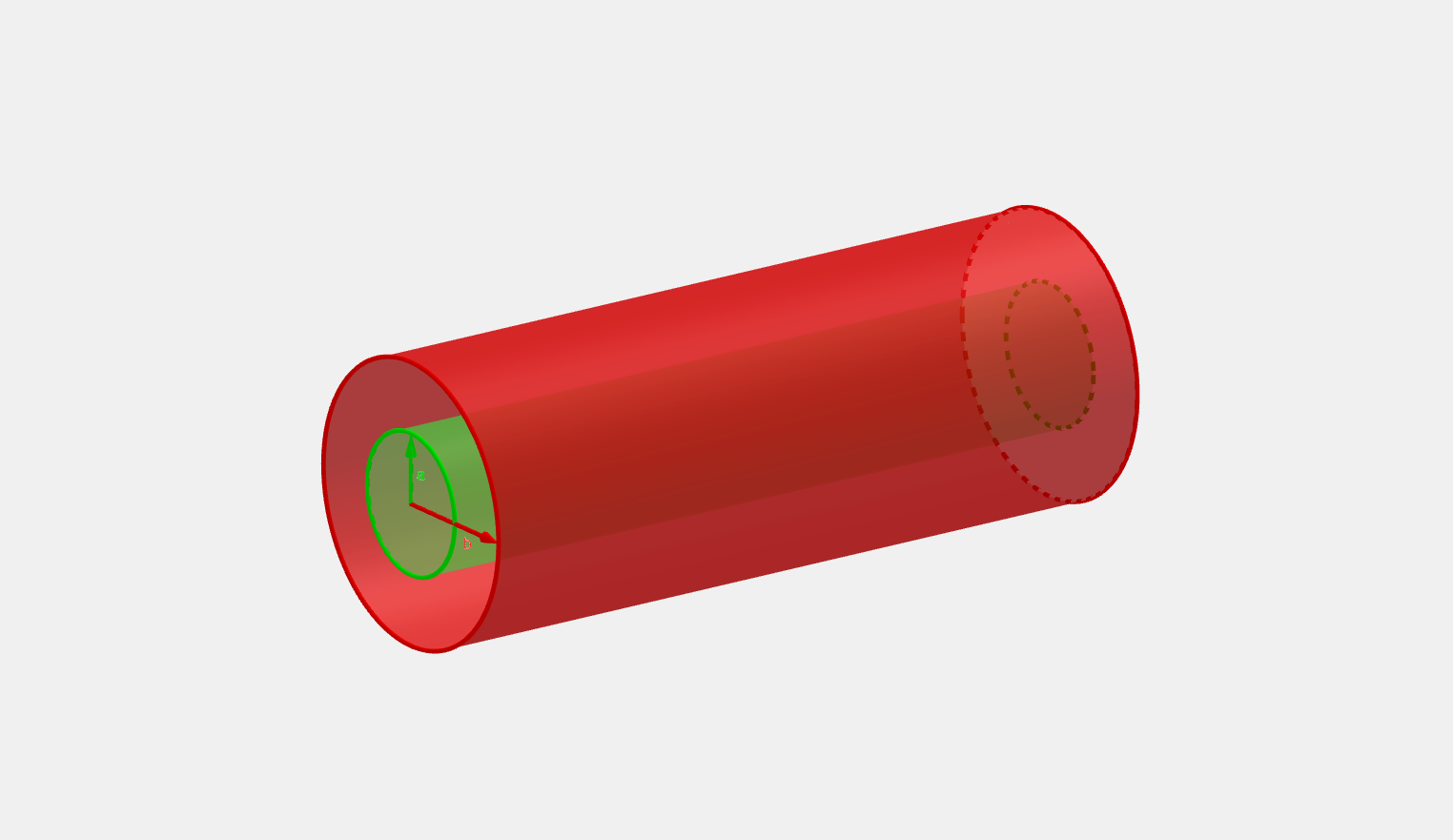
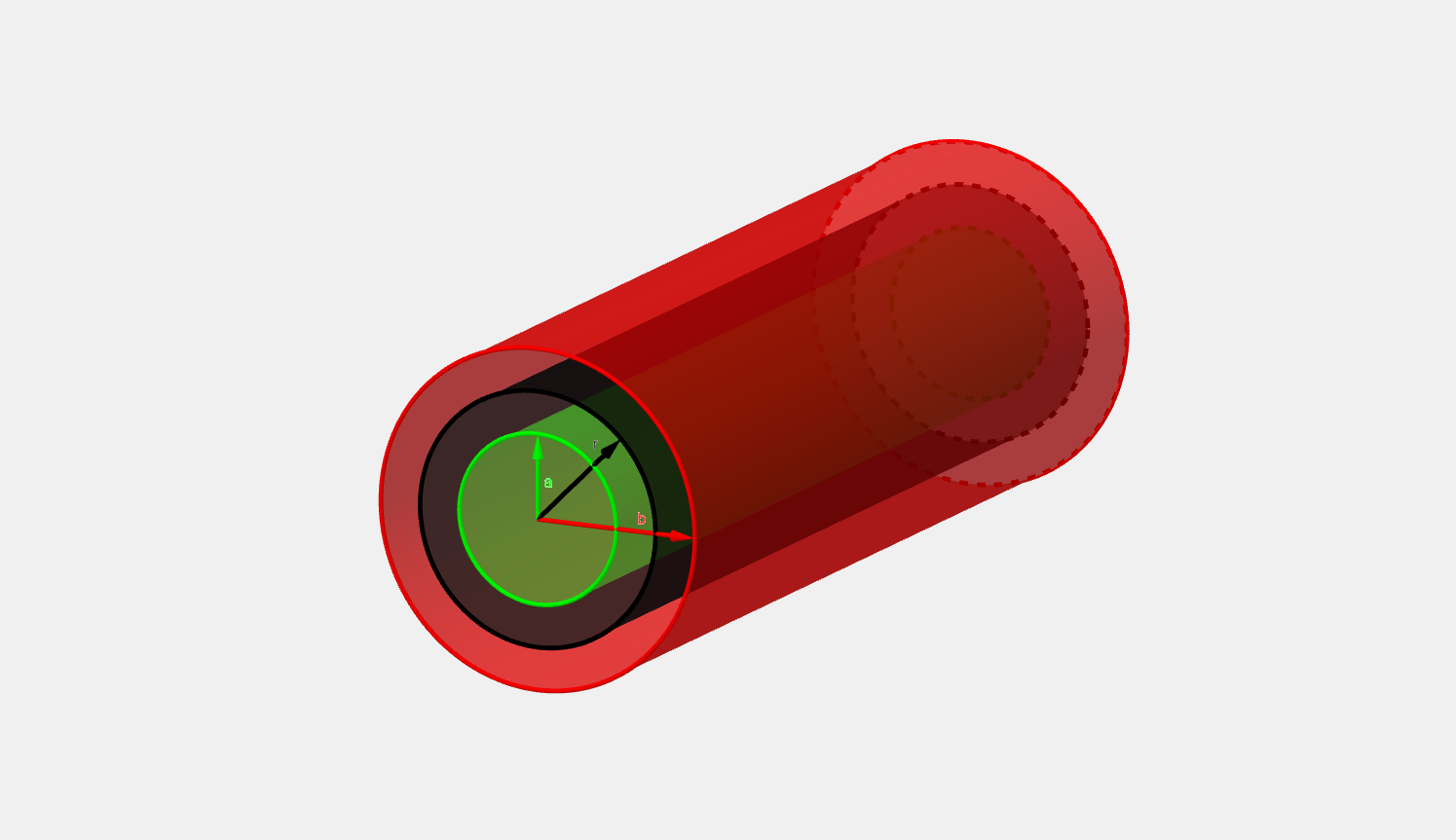
Cylindrical capacitor consists of a cylinder of radius a and a cylindrical shell of radius b of equal length L. The inner cylinder has a positive charge Q and the outer shell has a negative charge −Q:
We choose cylinder with radius r and equal length L as the gaussian surface:
The electric field is constant on the cylinder. Using Gauss's law to get the electric field:
ΦEE=∬SE⋅dA=EA=2EπrL=ϵ0q,=2ϵ0πrLq,
where q is the charge enclosed by the gaussian surface (black cylinder). If r<a then q=0. If r>b then q=Q+(−Q)=0. This implies a<r<b and thus q=Q. The voltage is equal to:
Spherical capacitor consists of two cocentric spheres. The inner sphere has radius a and a positive charge Q. The outer sphere has a negative charge −Q and a radius b. We choose a cocentric sphere of radius r as our gaussian surface:
The electric field is constant on the surface of the gaussian surface. Using Gauss's law, the electric field is equal to:
ϕEE=∬SE⋅dA=EA=4Eπr2=ϵ0q,=4ϵ0πr2q,
where q is the charged enclosed by the gaussian surface. Similarly to the cylindrical capacitor, the charge is nonzero only when a<r<b, thus q=Q. We can now calculate the voltage:
Capacitors can be used to store energy. Consider a capacitor with initial charge equal to zero. The potential energy is the external work done to charge the capacitor is given by:
Ep=Wext=∫0Q∣U∣dq=∫0QCqdq=2CQ2=21C∣U∣2,
where Q charge after the charging process and C is the capacitance.
Consider a parallel plate capacitor, where C=Aϵ0/d and ∣U∣=Ed then the potential energy is equal to:
Ep=21dAϵ0E2d2=21ϵ0E2Ad=21ϵ0E2V,
where V is the volume.
The energy density is the energy per unit volume:
ep=21ϵ0E2
For example, consider a spherical conductor of radius a. As derived with Gauss's law, the electric field outside is equal to:
The first is parallel and the second is serial. For parallel, the voltage across each capacitor is the same - ∣U∣, each capacitor has the capacitance Ci and charge Qi:
Ci=∣U∣Qi⟺Qi=∣U∣Ci.
The capacitors can be replaced by a single capacitor with capacitance C and charge Q:
QC=i∑Qi=i∑∣U∣Ci=∣U∣i∑Ci,=∣U∣Q=i∑Ci.
For serial, capacitors with capacitance Ci are connected to a battery with total voltage ∣U∣ each capacitor has voltage ∣Ui∣:
The outer plates have charges ±Q. The inner plates are charged to opposite charge. The voltage of each capacitor ∣Ui∣=CiQ and the total voltage is given by:
∣U∣=i∑∣Ui∣=i∑CiQ.
Again, the capacitors can be replaced with capacitor with capacitance C: